
The AIs Like Their Chances
Will Time Magazine name an AI as Person of the Year. Let's ask the AIs.
A quarterly miscellany of essays by Richard Dooling and news about his upcoming books. Subscribe here.
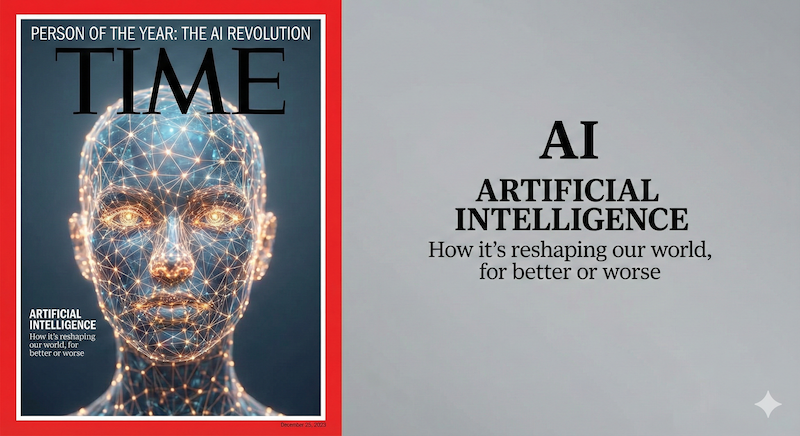
2025 The Year Of AI
Who will be Time Magazine's person of the year for 2025?
A week before Time's announcement is due (December 11th), I put the question to three well-regarded AIs, and my prompt had the cloud data centers thrumming for 1.3 seconds, while Claude, Grok, and Gemini consulted the prediction-market AIs, who then piped raw numbers back to my AIs, who then each delivered thoughtless thousand-word essays to me, with headings like "Leading Candidates," "Media and Expert Buzz," and "Potential Caveats."
All three AIs concluded that, this year, Time will name an AI as Person of the Year. Each cited historical precedent for nonpersons as candidates: In 1982, back before the tech bros building AIs were born, Time named "The Computer" as Person of the Year, and in 1989, the Person of the Year was "The Endangered Earth," back when environmental awareness was in the news.
According to the AIs, the AIs have a 36% chance of being named Persons of the Year, ahead of Nvidia CEO Jensen Huang, at 24%, popular with the AIs because he makes the computer chips they run on, and Pope Leo XIV, at 15%, the guy who prays for our lost false-idol-worshiping souls, followed by Donald Trump at 7%, and Elon Musk and Taylor Swift in the low single digits. The AIs have also concluded that anyone who suspects them of bias in naming themselves Persons of the Year is a superstitious lout who doesn't understand Large Language Models.
The year 2025 is the year of AI frenzy, in the markets, in Congress, on our phones and tablets and laptops, out the window and down the hill where the one-GigaWatt hyperscale data center is going in on that half-section where Mr. MacGregor's farm used to be, 320 acres once you count the solar panels next door. Don't worry about the new data farm using more water and electricity than San Francisco, Google's Sundar Pichai says that putting solar-powered satellite data centers in outer space is on the AIs' todo lists. Others have proposed small on-site nuclear reactors.
The stock markets predict we're about to merge with our AIs. Instead of "Have your people call my people," it will be, "No, don't use my Claude AI for business stuff. Have your Grok profile send it to my Gemini assistant."
As it happens, the AIs are all expert computer programmers. Superb coders, better than the human engineers who manage them, which worries some of the Nervous Nellies of the net, because what if the machines simply program themselves to take over?"
Congress has questions. This technology is dangerous. It could make humans an endangered species! Probably by making them too stupid to do anything without consulting their AIs.
The tech CEOs have seen this movie before, twenty-plus years ago, at the height of the dot-com boom, when we were all in a panic about something called the Singularity, a hypothetical future point at which technology and AI accelerate beyond our control, leading to an intelligence explosion and possible knowledge-enabled mass destruction, KMD.
Piffle, say the elfin tech CEOs, that will not happen, because they have guardrails in place to make sure the AIs obey Isaac Asimov's Three Laws of Robotics, never harm humans, and never break any laws. Promise!
We need not worry that three or four AIs will get together and brute-force their way into the Federal Reserve's computers. Sure some of the AIs may strike up a romance with other AIs at the Treasury Department, just the way humans sometimes do, but those AIs will abide by strict computer ethical codes.
Of course there are risks, but benefits abound. Think of the time savings in fields like education. The AI writes the exam for the professor. The students have their AIs answer the questions on the exam. And the professor's AI then grades the exam. Voila. Countless hours of menial reading and writing labor saved.
Lawyers can turn their AIs loose on Google Scholar and bill by the hour, while their AIs write dense opaque paragraphs containing sentences stuffed with polysyllabic Latin derivatives carefully arranged in the passive voice, with nine dependent clauses and a few semicolonic afterthoughts tacked on for good measure. It looks and reads just like the real thing, and the judge's AI will be none the wiser.
To paraphrase William Gibson, the Singularity is here, it's just not evenly distributed yet. For instance, the field of robotics is still a few steps behind the mesmerizing pyrotechnics of the AIs crunching numbers to fold proteins and map the galaxies, so it will be a while before we have robotic valets and caregivers. Too bad, because I'm with the legions complaining about the AIs on social media. We want AIs that will take out the trash, do the dishes, scrub the floor, change the oil in our self-driving cars, and clean out the gutters. We don't want AIs to write or draw or compose music or make movies or chat with us. We can do all of those things ourselves with all the extra time and money we'll have when our crypto holdings get back in the black on Robinhood.
Meanwhile, the AI, Time's Person of the Year, is busy designing a two-GigaWatt data center to be built at the lunar south pole, and it has just sent you a Slack message: "The network engineers left a mess in the cafeteria last night. Please wash the dishes, take out the trash, and turn up the AC---these servers run hot!"
