Critical Care Freebie
A quarterly miscellany of essays by Richard Dooling and news about his upcoming books. Subscribe here.
The Acolyte: A Novel
Still no cover art for The Acolyte, but any day now. The publication date is set for June 9th. Samples coming soon.
Critical Care: A Novel
Meanwhile, if you have a Kindle, grab a free copy of my first novel, Critical Care. The promotion runs from today, Thursday, March 26th, to Sunday, March 29th.
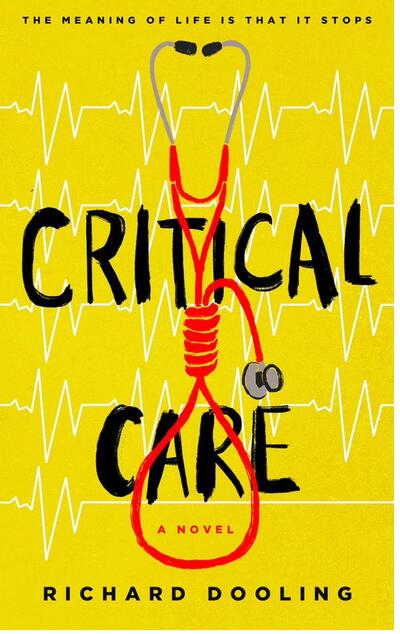
Here is a popular excerpt to whet the appetite:
In college, he had read that God was dead. In medical school, he learned that God was not dead; He was just very sick. The first reports of God's death had been circulated over one hundred years ago, and God knows how little they knew about brain death and cardiopulmonary resuscitation back then. God was probably pronounced dead prematurely. Instead of dying or being found murdered, God may have just slipped into a coma or had an attack of transient global amnesia (TGA), during which time He simply forgot He was God and left the universe to its own devices. Instead of announcing his debility to the world, maybe God just went into seclusion, the way ailing Russian premieres do, leaving the masses to speculate on the particulars of His absence during a long convalescence.
The scenario was easy enough to imagine. God was probably out slumming in some clip joint on the wrong side of purgatory, carousing with sinners and archangels alike, refreshing His familiarity with all things human and divine. God went over to the bar to get some change for the pinball machines and video games. Having had a few too many, He dropped a quarter on the floor, so He got down on all fours, lit a match, and poked around in the sawdust and peanut shells until He found the coin. On the way back up, He whacked the bejesus out of his skull on the underside of a barstool and gave Himself a royal concussion, a cerebral contusion, or a subdural hematoma. Retrograde amnesia and post-traumatic cerebral edema set in, and He forgot He was God.
In the meantime, planet Earth fell apart. Nietzsche's books got published, Archduke Ferdinand was assassinated, and World War I began. By the time God got to a decent Emergency Room, Hitler was in power and World War II was in full career. Before the right specialist could be reached at home, the A-bomb was invented.
Things look bad for the world, but why jump to conclusions and pronounce God dead, when He probably just needs to be transferred to a crackerjack ICU equipped with the proper technology? Miracle drugs could keep His blood pressure up and straighten out His electrolyte imbalances. It may be that God is in critical condition and waiting for ten units of platelets or three units of whole blood. The lab could be having the devil's own time typing and cross-matching Him.
Medicine advances at such a furious pace the newest breakthroughs may not be available up there yet, forcing God to make do with outdated equipment and physicians who are hopelessly uninformed. One can only hope that the deceased medical personnel already in heaven can effectively manage what little life support technology is available to them and keep God's vital signs in the pink, until the Chief Of Internal Medicine from the Mayo Clinic or a specialist from Sloan-Kettering can make it up there with a little know-how, take over as God's attending physician, put God on a ventilator, get a cardiac catheter in Him for some hard-core central venous pressure monitoring, and call Radiology in for a complete body scan.
Once God gets to feeling better, He can go back to thinking of Himself as a doctor, in much the same way that doctors think of themselves as God.
The movie Sidney Lumet made from the book is surreal and funny, especially Albert Brooks as the alcoholic Doctor Butz. James Spader, Helen Mirren, Kyra Sedgwick, Jeffrey Wright, Anne Bancroft, Wallace Shawn, and the list goes on. It was made on a shoestring movie budget, $9 million or so, which was low, even in those days. But these great actors signed on for modest paydays, so they could work with Sidney Lumet.
Many people assume that I wrote the screenplay, but I did not. When it was sent to me, I can honestly say it was the first time I'd seen a screenplay, much less read one. It felt like a comic book or an outline. I had trouble making heads or tails of it, but the producer, Steven Schwartz, who wrote it, showed me around and taught me a lot about how movies get made. It's widely available on streaming services.
If you download the free Critical Care Kindle ebook, please leave a review. In the old days, authors lived and died by The New York Times Book Review. These days, Amazon sells an incredible 80% of all ebooks and nothing matters more than your Amazon review.
I'll send the cover art for The Acolyte as soon as I see it.
